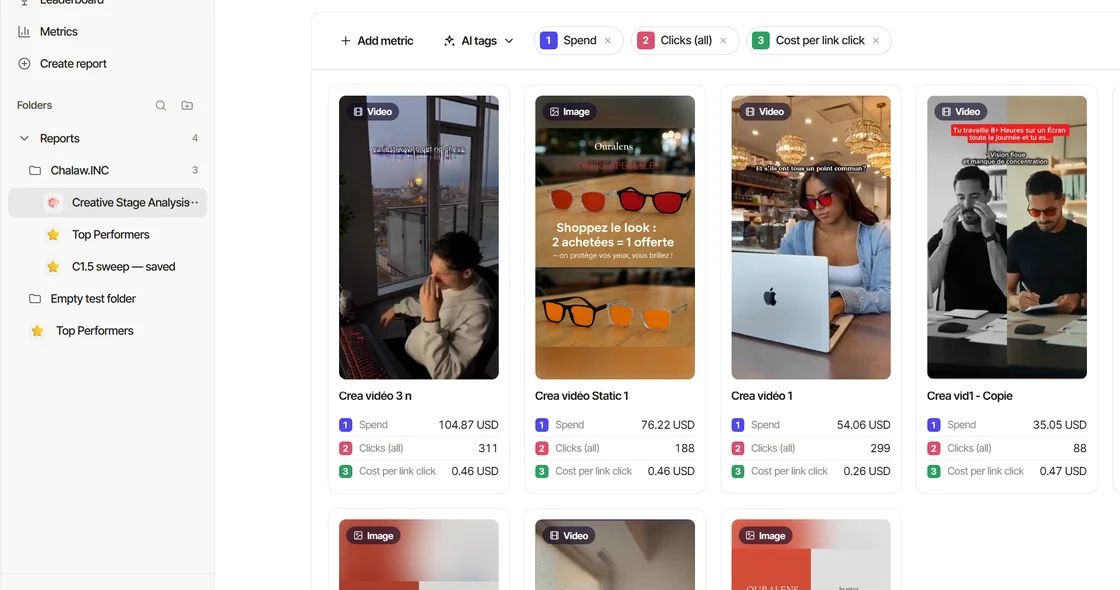
How to move through this, in order, to get the most out of it. Four phases: setup (once), daily (30 seconds), weekly (the core engine), monthly (the step back). Plus a guide for anything that doesn't fit the cadence.
Phase 0: setup (once per brand or client)
Done in one sitting, in the brand's own Project:
- Connect the data: your Meta ad account in Creativity, your Facebook Page for the comments, follow your competitors, then connect Claude or ChatGPT and pick the brand's workspace.
- Give Claude the combined brief in one message: brand voice, naming convention, KPIs, and contribution margin, target CPA and break-even CPA. The analysis can't judge profit without the economics half, so don't skip it.
You're now my creative strategist for [Brand name], working from my Creativity data.

Context:
- What we sell: [product / category]
- Currency: [currency]
- Contribution margin: [X%] | Break-even CPA: [X] | Target CPA: [X] | Target ROAS: [X]
- Naming convention for ads: [e.g. hook_format_angle_date]
- Brand voice in 3 words: [e.g. blunt, funny, premium]
- Our top competitors: [names]
- What "a winning ad" looks like for us: [short definition]

Then run Brand Intake: ask me only what this brief leaves blank, research the brand on the web, and write the brand context document. Use both for everything we do together in this project. If that skill is not installed, creativity_get_playbook holds the method.

End with exactly three numbered next steps for me to pick from:
1. What the last 90 days already taught us (Creative Analysis)
2. Customer research: the ad comments and reviews on the web, Instagram and Reddit (Review Audit)
3. Map the strategy: pain × persona × angle × awareness stage (Creative Strategy Engine)- If the account is already running (the common case), run the audit as well: it pulls the existing creatives and performance of the last 90 days, maps what's tested, classifies every angle and names the current bottleneck.
Run a full audit on [Brand name] with my Creativity data, following Creative Analysis' account audit: pull the existing creatives with their results and AI tags, and the campaign results. Map what has been tested, classify each angle as EXPLORE / EXPLOIT / ITERATE / ABANDON, and tell me what is limiting profitable growth before we make anything new. If that skill is not installed, creativity_get_playbook holds the method. Call Creativity's tools for the last 90 days even if earlier answers in this chat cover it: creativity_get_account_performance against the period before, creativity_search_creatives and creativity_analyze_tags. A window I name replaces it. Then build one report artifact, charted as the connector skill's Report artifacts says (without it, creativity_get_playbook's notes), every AI tag in Creativity's tag colours. In the chat, keep only the verdict and the three next steps; where artifacts can't be shown, answer in full in the chat.
End with exactly three numbered next steps for me to pick from:
1. A deep 90-day analysis of every creative (Creative Analysis)
2. Customer research for the top pain point and desire (Review Audit)
3. New concepts from the winners as test briefs: best formats, best hooks, untried formats (Creative Mechanics)- Set up the recurring cadence below as scheduled tasks (see "Scheduling" at the end), or run it by hand in the same Project.
Efficiency rule: one Project per brand, never restarted. Creativity remembers nothing between chats: your brief, your angle classifications and your past reviews live in the Project. Setup happens once; treat "re-explaining the brand" as a bug, not a normal step.
Phase 1: daily (30 seconds, don't decide anything)
One prompt, the economics scan: yesterday against the day before and the last 7 days. Its purpose is catching a deviation early, not making a decision: kill, scale and structure calls don't belong here. This is a scan, not a review, so it answers in text.
Daily check for [Brand name]: compare yesterday's spend, revenue, ROAS, CPA, AOV, CPM, CTR, CPC and conversion rate with the day before and the last 7 days. Is anything deviating before I open Ads Manager? This is a scan: flag, don't recommend changes. Read it the Creative Analysis way: observed, inferred or unknown. If that skill is not installed, creativity_get_playbook holds the method. Call creativity_get_account_performance for yesterday and for the last 7 days even if earlier answers in this chat cover them. A day I name replaces yesterday.
End with exactly three numbered next steps for me to pick from:
1. A deep 90-day analysis of every creative (Creative Analysis)
2. Customer research for the top pain point and desire (Review Audit)
3. New concepts from the winners as test briefs: best formats, best hooks, untried formats (Creative Mechanics)Phase 2: weekly (the actual engine, run in this order)
The order matters: each step feeds the next one's context, so don't run them out of sequence or in isolation.
- The weekly creative strategy review (Creative Analysis): the last 7 days against the 7 before. It produces the angle classification updates, the current bottleneck and a numbered list of hypotheses. In Claude, it comes as a report: the verdict, the key numbers with their change, your creatives and AI tags charted, and the hypotheses; the chat keeps the verdict and the three next steps.
Run the weekly creative strategy review for [Brand name], following Creative Analysis' weekly review: strongest creatives, winning angles, disproven angles, untested angles, the current bottleneck, winners needing expansion, and the next 3 to 10 hypotheses for the production queue. If that skill is not installed, creativity_get_playbook holds the method. Call Creativity's tools for the last 7 days even if earlier answers in this chat cover it: creativity_get_account_performance against the period before, creativity_search_creatives and creativity_analyze_tags. A window I name replaces it. Then build one report artifact, charted as the connector skill's Report artifacts says (without it, creativity_get_playbook's notes), every AI tag in Creativity's tag colours. In the chat, keep only the verdict and the three next steps; where artifacts can't be shown, answer in full in the chat.
End with exactly three numbered next steps for me to pick from:
1. A deep 90-day analysis of every creative (Creative Analysis)
2. Customer research for the top pain point and desire (Review Audit)
3. New concepts from the winners as test briefs: best formats, best hooks, untried formats (Creative Mechanics)- Act on the hypotheses that need new creative: take the specific hypotheses from step 1 to hooks and concepts (Hook Writing, Creative Mechanics, Visual Formats). Don't ask for copy before step 1: writing hooks against an unproven angle wastes a test slot (the testing hierarchy: angle before hook).
- Check the customers' words: for the hypothesis you're least sure of, read what the comments under your ads say about it (Review Audit) before you brief it.
- Read what ran last week: once new creatives have a few days of data, ask Claude to deconstruct them with their storyboards, transcripts, copy and the AI tags Creativity added. This becomes next week's input to step 1.
This is the loop in practice: existing reality → intelligence → diagnosis → hypotheses → test → back to intelligence. Keep it in the same Project so week 2's review can reference week 1's classifications instead of rebuilding them.
Phase 3: monthly (structural, not tactical)
Run the monthly review: the last 30 days against the 30 before, with marginal CPA and the profitable spend ceiling. This is where structural and budget changes belong, not weekly. Reacting to weekly noise with structural change breaks the kill-criteria discipline: no killing or restructuring off one bad week.
Run the monthly review for [Brand name] with Creative Analysis: the best concept, angle, offer, persona, format and proof this month; the biggest deterioration and its likely cause; marginal CPA and the profitable spend ceiling; the next operational constraint; and the highest-upside experiment for next cycle. If that skill is not installed, creativity_get_playbook holds the method. Call Creativity's tools for the last 30 days even if earlier answers in this chat cover it: creativity_get_account_performance against the period before, creativity_search_creatives and creativity_analyze_tags. A window I name replaces it. Then build one report artifact, charted as the connector skill's Report artifacts says (without it, creativity_get_playbook's notes), every AI tag in Creativity's tag colours. In the chat, keep only the verdict and the three next steps; where artifacts can't be shown, answer in full in the chat.
End with exactly three numbered next steps for me to pick from:
1. A deep 90-day analysis of every creative (Creative Analysis)
2. Customer research for the top pain point and desire (Review Audit)
3. New concepts from the winners as test briefs: best formats, best hooks, untried formats (Creative Mechanics)Phase 4: ad hoc (something happened outside the cadence)
- "Performance moved" → ask for the cascade (CPM, CTR, CPC, conversion rate, AOV) on the window that moved. A creative cause then goes to the creatives and their tags; an economics cause to your brief's numbers.
- "A competitor did something" → ask what they are running now. If it touches an angle you EXPLOIT or ABANDONED, ask for a classification update.
- "I need new copy right now" → hooks, only if the angle is already classified EXPLORE or EXPLOIT. Otherwise, analysis first.
- "Should we scale or kill this?" → it needs both the diagnosis (is it real?) and the economics (is it worth it?): ask for both in one message.
- "I'm not sure what to ask" → "What should we test next?", or pick one of the three next steps the last answer ended with.
Windows and fresh numbers
Each routine fetches its own numbers when you run it, even if the chat already holds older answers: the daily check reads yesterday and the last 7 days, the weekly review the last 7 days, the monthly review the last 30, the audit and "what should we test next" the last 90, each against the period before. Name another window to replace it: "Weekly review for 1 to 15 September."
The five commands
With the Creativity strategist plugin in Claude, each routine is a command:
/daily-check: phase 1, the economics scan./weekly-review: phase 2, step 1./monthly-review: phase 3./audit: phase 0, step 3, for an account that's already running./strategy-run: the whole method, one step at a time, for a new brand or a new product.
Type anything after a command to add to it, like /weekly-review for 1 to 15 September. Without the plugin, the buttons above open the same prompts.
Scheduling
We have not tested scheduled tasks with Creativity yet. The steps below follow Anthropic's and OpenAI's documentation; tell us how it goes.
- Claude: in Claude's desktop app, Cowork can run a prompt on a schedule with your connectors, on paid plans. A task that only uses connectors, like these, runs in the cloud even while your computer is asleep; one that needs files on your computer waits for it. Schedule the daily check each morning, the weekly review on Monday and the monthly review on the first of the month, each in the brand's Project.
- ChatGPT: scheduled tasks can use connected apps. ChatGPT runs them at most about once an hour and limits how many you keep (3, 5 or 15, depending on your plan).
- By hand: send the same prompts in the same Project on the cadence above. Label each one with its aim, so you know why you're running it, not just that it's due.
Efficiency principles (what actually makes this fast, not just possible)
- Never front-load creative before diagnosis. The most common inefficiency is asking for hooks or copy before an angle has been classified: it produces plausible-sounding output against an unvalidated idea.
- One Project per brand, never reset. Compounding context is the entire point; a fresh thread is a fresh brief every time.
- Daily ≠ weekly ≠ monthly in scope. Daily catches, weekly acts, monthly restructures. Collapsing them into "just ask whenever" produces reactive, noisy decisions.
- Let the three next steps lead when you don't know what to ask: each answer ends with them, and picking one keeps the method in order.
- Agencies: one Project per client, always, and the right workspace on the connection before you start. Mixing two brands' naming conventions or angle maps is the most likely failure as usage grows.