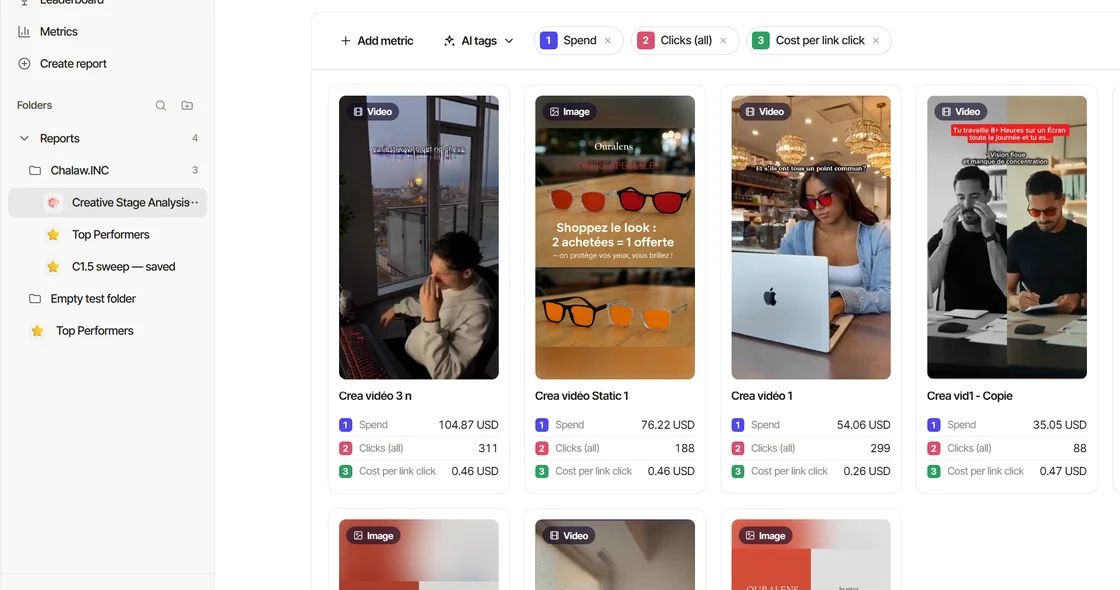
Every prompt below assumes the brand brief is done (Step 2 of the guide). Copy, adapt the bracketed parts, done. The headings are the skills that answer; you never have to name them.
Creative Analysis: what's spending, what's winning, and why
Aim: know the numbers without opening a dashboard.
- "Give me a plain-English recap of this week's Meta performance vs. last week. What moved and why?"
- "Which ads are beating our target CPA right now? Which are furthest from it?"
- "Build me a table of our top 5 and bottom 5 ads this month by ROAS."
- "We just changed [budget / audience] on [campaign]: did it actually move anything?"
Aim: stop guessing what to test next.
- "Look at our last 20 ads by their AI tags (hook, visual format, angle) and tell me which combination is winning."
- "What creative pattern shows up across our best-performing ads that isn't in our worst ones?"
- "What hook, format and angle values have we never tested?"
- "Is [creator / UGC style] actually outperforming [polished / studio style] for us, or does it just feel that way?"
Aim: turn evidence into a decision, not just a pattern.
- "Deconstruct our top-performing ad this month: who's it for, what belief does it activate, and what actually made the promise believable?"
- "Look at our top ad's storyboard and tell me what the first three seconds show."
- "Classify our current angles as EXPLORE, EXPLOIT, ITERATE or ABANDON, with evidence for each."
- "What's our current creative bottleneck: we don't know the angle, we don't have enough concepts, or the execution is holding a good concept back?"
- "Write a test hypothesis for [idea]: what we believe, what's actually changing, what stays fixed, and what we'll do depending on the result."
Aim: read the account's economics like a portfolio.
- "Walk the cascade on our CPA increase: is it CPM, CTR, CPC, conversion rate or AOV, and what does that point to?"
- "Where are we against the break-even and target CPA in our brief right now?"
- "Is our marginal CPA still attractive if we scale spend by [X]? Compare it to break-even, not the average."
- "Compare our campaigns and ad sets this month: which ones carry the results?"
- "Are any of our tests actually pseudo-tests, changing more than one variable and calling it a learning?"
Taking over an account? Run the full audit:
Run a full audit on [Brand name] with my Creativity data, following Creative Analysis' account audit: pull the existing creatives with their results and AI tags, and the campaign results. Map what has been tested, classify each angle as EXPLORE / EXPLOIT / ITERATE / ABANDON, and tell me what is limiting profitable growth before we make anything new. If that skill is not installed, creativity_get_playbook holds the method. Call Creativity's tools for the last 90 days even if earlier answers in this chat cover it: creativity_get_account_performance against the period before, creativity_search_creatives and creativity_analyze_tags. A window I name replaces it. Then build one report artifact, charted as the connector skill's Report artifacts says (without it, creativity_get_playbook's notes), every AI tag in Creativity's tag colours. In the chat, keep only the verdict and the three next steps; where artifacts can't be shown, answer in full in the chat.
End with exactly three numbered next steps for me to pick from:
1. A deep 90-day analysis of every creative (Creative Analysis)
2. Customer research for the top pain point and desire (Review Audit)
3. New concepts from the winners as test briefs: best formats, best hooks, untried formats (Creative Mechanics)Review Audit: what customers actually say
Aim: hear the customer before you write a word. It needs your Facebook Page connected for the comments.
- "What objections and doubts come up in the comments under our ads this month? Quote them."
- "How many comments under [ad name] ask the price? Read every page before you count."
- "Find reviews of [brand] and [competitor] on the web, Instagram and Reddit, and give me the top pain point and the top desire in the customers' own words."
Creative Strategy Engine: what to say, to whom
Aim: a map, not a list of ideas.
- "Map our pains × personas × angles × awareness stages from what our winners and the comments already tell us."
- "Which awareness stages do our running ads cover, and which are empty?"
Hook Writing, Hook Tactics and Hook Voice Patterns: words you can ship
Aim: turn insight into something you can ship, not just a chart.
- "Based on what's winning for us, write 5 new hook variations for [product]."
- "Give me hooks for our lead angle across 5 different tactics, for a hook test."
- "Rewrite these hooks in the feed's native voice."
- "Write captions for [campaign name], pulling language from our best ads' transcripts, copy and comments."
Creative Mechanics and Visual Formats: concepts and how they look
Aim: from an angle to a brief a creator can shoot.
- "Write 3 ad concepts using our best-performing angle, each with a different mechanic."
- "Take our best angle and build an expansion matrix across situation, desire, mechanism, proof and format."
- "Which visual formats have we never run, and which one would suit [angle]?"
Competitors
Aim: know what the market is doing before it shows up in your numbers.
- "What are [Competitor A] and [Competitor B] currently running? Any new angles since last month?"
- "Are competitors testing anything we haven't touched yet?"
- "Pull 5 competitor ads with a similar hook to ours: how are they framing it differently?"
- "Take our top competitor's hook and give me an on-brand version for us."
Competitor ads carry no spend or results: Meta's ad library doesn't publish them.
Your saved reports
Aim: keep the reports your team opens every Monday up to date. Reading and running them always works; creating, changing, deleting and restoring them needs Allow edits on this connection (Connect Claude explains it).
- "List my saved reports and run [report name] for last week."
- "Show me the settings of [report name]."
- "Save a report called [title]: creatives of the last 30 days, grouped by creative, as a line chart of spend and CTR."
- "In [report name], keep only creatives with at least 50 in spend." Claude sets the filter
{"field": "metric:spend", "operator": "gte", "value": 50}. Filters replace the report's own, the template's included, so ask for every filter you want to keep. - "Delete [report name]." Then, if you change your mind: "Restore [report name]."
Chained asks (the highest-value pattern)
These deliberately need more than one skill. This is where it stops feeling like a chatbot:
- "Why did [ad name] outperform everything else this month, and what should we test next based on that?"
- "Compare our current angle to what [competitor] is running, then write 3 hooks that close the gap."
- "Build a one-page brief for next sprint: what won, what customers say, what the white space is, and 5 hooks to test it."
Recurring prompts (routines)
Set these up as standing habits, not one-offs. Suggested cadence below; adjust to your spend level. Your routine shows the order to run them in and how to schedule them. Each one fetches its own window fresh, and you can name another: "for 1 to 15 September".
Daily: the economics scan, without compulsive optimization.
Daily check for [Brand name]: compare yesterday's spend, revenue, ROAS, CPA, AOV, CPM, CTR, CPC and conversion rate with the day before and the last 7 days. Is anything deviating before I open Ads Manager? This is a scan: flag, don't recommend changes. Read it the Creative Analysis way: observed, inferred or unknown. If that skill is not installed, creativity_get_playbook holds the method. Call creativity_get_account_performance for yesterday and for the last 7 days even if earlier answers in this chat cover them. A day I name replaces yesterday.
End with exactly three numbered next steps for me to pick from:
1. A deep 90-day analysis of every creative (Creative Analysis)
2. Customer research for the top pain point and desire (Review Audit)
3. New concepts from the winners as test briefs: best formats, best hooks, untried formats (Creative Mechanics)Weekly: keeps creative intelligence current instead of a quarterly backlog. "Look at this week's new creatives and their AI tags: is a pattern emerging?"
Every two weeks: keeps competitor awareness ambient instead of reactive. "What are our top 3 competitors running right now that we're not?"
Weekly: the flagship routine. It replaces the whole Monday strategy meeting with one ready-to-brief output: in Claude, a report with the verdict, the numbers against last week, your creatives and AI tags charted, and the hypotheses.
Run the weekly creative strategy review for [Brand name], following Creative Analysis' weekly review: strongest creatives, winning angles, disproven angles, untested angles, the current bottleneck, winners needing expansion, and the next 3 to 10 hypotheses for the production queue. If that skill is not installed, creativity_get_playbook holds the method. Call Creativity's tools for the last 7 days even if earlier answers in this chat cover it: creativity_get_account_performance against the period before, creativity_search_creatives and creativity_analyze_tags. A window I name replaces it. Then build one report artifact, charted as the connector skill's Report artifacts says (without it, creativity_get_playbook's notes), every AI tag in Creativity's tag colours. In the chat, keep only the verdict and the three next steps; where artifacts can't be shown, answer in full in the chat.
End with exactly three numbered next steps for me to pick from:
1. A deep 90-day analysis of every creative (Creative Analysis)
2. Customer research for the top pain point and desire (Review Audit)
3. New concepts from the winners as test briefs: best formats, best hooks, untried formats (Creative Mechanics)Monthly: the account-level counterpart to the weekly creative review: money and structure, not just creative.
Run the monthly review for [Brand name] with Creative Analysis: the best concept, angle, offer, persona, format and proof this month; the biggest deterioration and its likely cause; marginal CPA and the profitable spend ceiling; the next operational constraint; and the highest-upside experiment for next cycle. If that skill is not installed, creativity_get_playbook holds the method. Call Creativity's tools for the last 30 days even if earlier answers in this chat cover it: creativity_get_account_performance against the period before, creativity_search_creatives and creativity_analyze_tags. A window I name replaces it. Then build one report artifact, charted as the connector skill's Report artifacts says (without it, creativity_get_playbook's notes), every AI tag in Creativity's tag colours. In the chat, keep only the verdict and the three next steps; where artifacts can't be shown, answer in full in the chat.
End with exactly three numbered next steps for me to pick from:
1. A deep 90-day analysis of every creative (Creative Analysis)
2. Customer research for the top pain point and desire (Review Audit)
3. New concepts from the winners as test briefs: best formats, best hooks, untried formats (Creative Mechanics)Monthly: keeps the data clean so every analysis stays accurate. "Review our ad naming convention: is anything named inconsistently this month?"