The one idea that changes everything
Most people open Claude and type a blank question. That's why the answer feels generic.
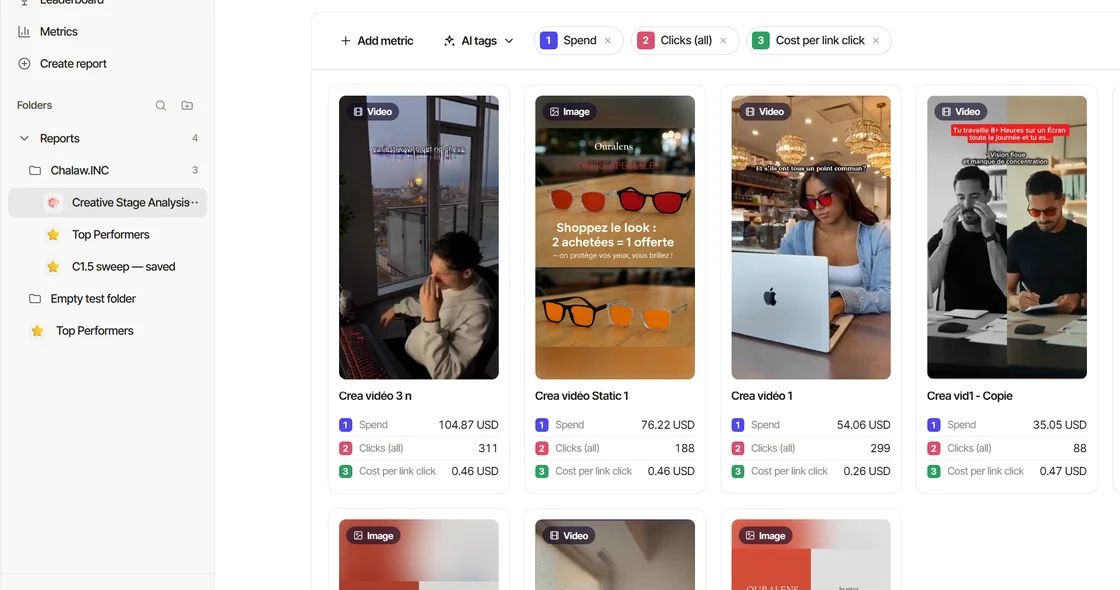
With Creativity connected, Claude isn't starting blank. It can already read your Meta ad performance, your creatives with their transcripts, ad copy and AI tags, the comments under your ads, and the competitor ad library. The job isn't "write a good prompt". It's tell Claude who it's working for once, then ask it for the thing you actually want, in plain language.
Think of it in two layers:
- Layer 1: the brief (once per brand). You tell Claude the brand voice, your economics, your naming convention and what "winning" looks like. Keep it in a Claude Project (or a ChatGPT project) for that brand, so every chat there starts from it. Creativity itself does not store it.
- Layer 2: the ask (every time). Short, natural-language requests that lean on Layer 1. "Why did this ad win?" means something specific once Claude already knows your target CPA and your naming convention.
Everything below is built on that split.
Setup: 3 steps
Step 1: connect the data
Connect your Meta ad account in Creativity, then connect Claude or ChatGPT to Creativity (Connect Claude) and pick the workspace for the brand. Claude can then act like an analyst instead of a guesser. Follow your competitors in Creativity to bring the competitor ad library into it, and connect your Facebook Page to bring in the comments under your ads.
Step 2: brief Claude once per brand
Open a new Project for the brand and send the brief. Fill in the brackets:
You're now my creative strategist for [Brand name], working from my Creativity data.

Context:
- What we sell: [product / category]
- Currency: [currency]
- Contribution margin: [X%] | Break-even CPA: [X] | Target CPA: [X] | Target ROAS: [X]
- Naming convention for ads: [e.g. hook_format_angle_date]
- Brand voice in 3 words: [e.g. blunt, funny, premium]
- Our top competitors: [names]
- What "a winning ad" looks like for us: [short definition]

Then run Brand Intake: ask me only what this brief leaves blank, research the brand on the web, and write the brand context document. Use both for everything we do together in this project. If that skill is not installed, creativity_get_playbook holds the method.

End with exactly three numbered next steps for me to pick from:
1. What the last 90 days already taught us (Creative Analysis)
2. Customer research: the ad comments and reviews on the web, Instagram and Reddit (Review Audit)
3. Map the strategy: pain × persona × angle × awareness stage (Creative Strategy Engine)Claude then runs Brand Intake: it asks only what the brief leaves blank, researches the brand on the web and writes a brand context document. Put both in the Project's instructions, or keep working in that Project: every session after this one starts smarter, not from zero.
If you're taking over an account that's already running (the far more common case for agencies), the brief isn't enough on its own: the account already holds evidence you need to surface first. Ask for a full audit:
Run a full audit on [Brand name] with my Creativity data, following Creative Analysis' account audit: pull the existing creatives with their results and AI tags, and the campaign results. Map what has been tested, classify each angle as EXPLORE / EXPLOIT / ITERATE / ABANDON, and tell me what is limiting profitable growth before we make anything new. If that skill is not installed, creativity_get_playbook holds the method. Call Creativity's tools for the last 90 days even if earlier answers in this chat cover it: creativity_get_account_performance against the period before, creativity_search_creatives and creativity_analyze_tags. A window I name replaces it. Then build one report artifact, charted as the connector skill's Report artifacts says (without it, creativity_get_playbook's notes), every AI tag in Creativity's tag colours. In the chat, keep only the verdict and the three next steps; where artifacts can't be shown, answer in full in the chat.
End with exactly three numbered next steps for me to pick from:
1. A deep 90-day analysis of every creative (Creative Analysis)
2. Customer research for the top pain point and desire (Review Audit)
3. New concepts from the winners as test briefs: best formats, best hooks, untried formats (Creative Mechanics)It pulls the creatives with their results and AI tags, maps what has been tested, classifies every angle as EXPLORE, EXPLOIT, ITERATE or ABANDON, and names what is limiting profitable growth. In Claude, it ends with a report you can read at a glance: the verdict, the key numbers against the period before, your creatives and AI tags charted, and the hypotheses to test.
Step 3: start asking, in plain language
Don't write "prompts". Talk to it like you'd talk to a strategist who already read the brief. The prompt library has exact examples by task.
The nine skills behind the answers
Claude works from a creative strategy method in nine skills. With the Creativity strategist plugin they are installed in Claude (Connect Claude shows how); without it, Claude reads the same method from Creativity when you ask for strategy. You never have to name a skill: ask for the thing, and Claude picks it.
- Brand Intake: the brief and the brand context document.
- Creative Analysis: your performance data and creatives: what was tested, why winners won, the bottleneck, and the hypotheses to test next. It runs the audit, the daily check and the weekly and monthly reviews.
- Review Audit: customer research. The comments under your ads and the reviews Claude finds on the web, Instagram and Reddit, turned into pains, desires and the customers' own words.
- Creative Strategy Engine: pains × personas × angles × awareness stages: the map of what to say, to whom.
- Hook Writing, with Hook Tactics and Hook Voice Patterns: hooks for the lead angles, by tactic, in the feed's native voice.
- Creative Mechanics: the structure that turns an angle into an ad concept.
- Visual Formats: how each concept should look: the format for each one.
A single ask can pull from more than one skill at once; that's the point. "Why is this ad winning, and what should we test next?" needs Creative Analysis and Creative Mechanics together. Claude figures out the join.
Three next steps, every time
Every analysis ends with exactly three numbered next steps, taken from the skill that produced it. Pick one by its number and Claude does it. After a weekly review, for example: a deep 90-day analysis of every creative, customer research for the top pain point, or new concepts from the winners as test briefs. It is the fastest way to keep a thread moving without deciding what to ask.
The full strategy run
Want the whole method, step by step? The strategy run goes through brand intake, creative analysis, customer research, the strategy map, hooks, concepts, formats and a test plan. Each step ends with its own artifact and three next steps (the first one: continue), and waits for your pick:
Run a full creative strategy for [Brand name] with my Creativity data, one step at a time. Each step follows its skill (if the skills are not installed, creativity_get_playbook holds the method), ends with its artifact and three numbered next steps (the first: continue to the next step), and waits for my pick:
1. Brand Intake: reuse the brief already in this chat or Project and ask me only what it leaves blank.
2. Creative Analysis: the account audit on my creatives, tags and results.
3. Review Audit: customer research on my ads' comments and the reviews you find on the web, Instagram and Reddit.
4. Creative Strategy Engine: pains × personas × angles × awareness stages, from steps 2 and 3.
5. Hook Writing, with Hook Tactics and Hook Voice Patterns: hooks for the lead angles.
6. Creative Mechanics: a concept per lead angle.
7. Visual Formats: the format for each concept.
8. The test plan: Creative Analysis' hypothesis briefs, ranked.

Start with step 1.In Claude with the plugin, it's the /strategy-run command.
Agency vs. single-brand setup
Single brand: one Project = one brain. Brief once (Step 2), keep using the same Project for that brand.
Agency managing several clients: create one Claude Project per client, each with its own brief. Never mix two clients' context in one thread: context is a superpower until it starts blending Brand A's naming convention into Brand B's report. Name Projects clearly (Client, BrandName) so switching context is a click, not a re-explanation.
A connection reads one workspace at a time, the one picked for it in Settings → Account → Connect AI. Changing it there changes it for every chat on that connection, so switch the workspace before you open the other client's Project, and ask "Which Creativity workspace can you read?" when in doubt.
Either way, the brief only needs to be written once per brand. Treat re-explaining the brand as a bug, not a normal step.
Building on threads (the "multiplayer" pattern)
The highest-value use isn't one-shot Q&A. It's a thread that builds:
- "Pull last week's Meta performance and tell me what won."
- "Now look at those by their AI tags, hook and visual format: what pattern do you see?"
- "What do people say in the comments under the winners?"
- "Check if any competitors are running something similar right now."
- "Write 5 new hook variations based on what's working and what's missing."
Each step reuses the last one's output. This is the difference between "Claude answered a question" and "Claude did a strategist's afternoon of work". Keep going in the same thread instead of starting fresh each time: the brief and the thread history both compound. When you run a review, though, Claude fetches that review's numbers fresh, even if the thread already has older ones.
Cheat sheet (keep this visible)
- New brand? Run the Step 2 brief first. Always.
- Agency? One Project per client, and the right workspace on the connection.
- Don't know what to ask? "What should we test next?" is always a valid start once data is connected:
What should [Brand name] test next? Follow Creative Analysis' "what do we test next" mode: work from our winning creatives, the AI tag values we have never tested, and what competitors are running now. Give me 3 to 5 test ideas as hypothesis briefs, each with the hypothesis and what stays fixed. If that skill is not installed, creativity_get_playbook holds the method. Call Creativity's tools for the last 90 days even if earlier answers in this chat cover it: creativity_get_account_performance against the period before, creativity_search_creatives and creativity_analyze_tags. A window I name replaces it. Then build one report artifact, charted as the connector skill's Report artifacts says (without it, creativity_get_playbook's notes), every AI tag in Creativity's tag colours. In the chat, keep only the verdict and the three next steps; where artifacts can't be shown, answer in full in the chat.
End with exactly three numbered next steps for me to pick from:
1. A deep 90-day analysis of every creative (Creative Analysis)
2. Customer research for the top pain point and desire (Review Audit)
3. New concepts from the winners as test briefs: best formats, best hooks, untried formats (Creative Mechanics)- Stuck after an answer? Pick one of its three next steps.
- Want a recurring habit, not a one-off? See your daily, weekly and monthly routine.
- Answer feels generic? The brief is probably missing or stale. Send it again with updated numbers.