Ask a founder what a creative strategist does and you will usually hear some version of "they know which ads will work." It's a flattering job description, and it's wrong.
Nobody knows which ad will work. Not the founder, not the agency, not the strategist with ten years of swipe files. Meta's delivery system decides, in the auction, ad by ad, and most of what it decides is "not this one." The strategist's job in 2026 isn't to predict the winner. It's to build the system that keeps finding winners, week after week, even though most ads won't be one.
Here is what that job looks like in practice.
1. Accept that winners are rare, and plan for it
In almost every account, a small handful of ads take most of the spend, and most ads barely spend at all. That isn't a sign your team is bad at ads. It's how performance advertising behaves: the algorithm concentrates budget on whatever is working best right now and starves the rest.
Once you accept that, a lot of anxiety goes away. An ad that never spent didn't "fail" in the sense of being a bad idea; it lost an auction to a sibling. The question stops being "why are most of our ads losing?" and becomes "are we giving ourselves enough chances to find the next one?"
In practice: stop judging a creative team by how many of its ads "worked." Judge it by whether the account keeps producing new winners.
2. Treat creative volume as capacity planning
If winners are rare, the number of real attempts matters. An account that launches two new ideas a month is waiting for luck. An account that launches meaningful new ideas every week gives the system something to find.
This is where most strategy breaks down, and it's rarely for lack of ideas. It's capacity: briefs, shoots, edits, approvals. So part of the job is unglamorous planning. How many genuinely new concepts can we ship per week with the people and budget we have? What's slowing that down? What can we make faster without making it worse?
Two warnings:
- Volume means ideas, not variations. Ten versions of the same ad with different colours is one test, not ten. A new angle, a new persona, a new format: those are new tickets.
- Volume without learning is noise. Every launch should carry a hypothesis you can read afterwards, or you are just spending money faster.
In practice: set a weekly number of new concepts the team commits to, and protect it like a budget line.
3. Read the winners, not the losers
When an ad dies, the instinct is to autopsy it. Usually there isn't much to learn: it lost an auction to an ad the system preferred, and the reasons are buried in delivery you can't see.
Winners are different. A winner is the clearest signal the market ever gives you. Who was it for? Which pain or desire did it lead with? What did the first three seconds do? What made the promise believable? What format carried it? Every one of those is a lever you can pull again, deliberately, in the next batch.
In practice: spend your analysis time on the top of the leaderboard. Deconstruct every winner into angle, persona, hook, format and proof, and turn each element into the next round of tests.
4. Respect the middle of the leaderboard
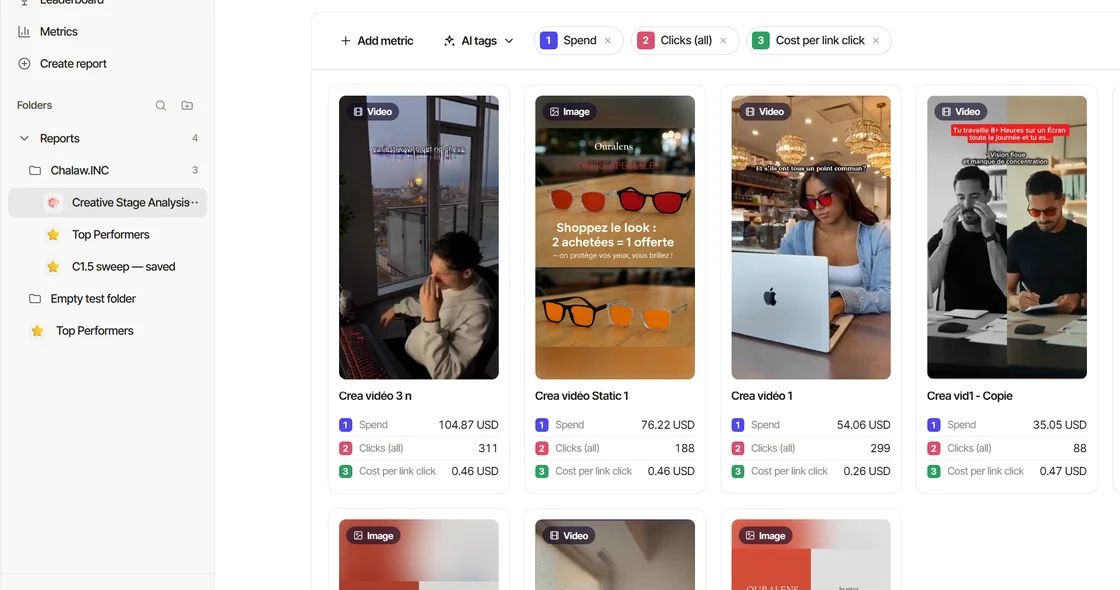
Between the stars and the ads that never spent, there's a group nobody talks about: ads that keep running week after week with steady spend, never spectacular, never off. In a lot of accounts they quietly carry the results while the team chases the next big winner.
Calling them failed tests is a mistake. They are the account's backbone, and a strategist protects them: don't switch them off to "make room," don't rebuild the account around last week's spike, and use them as the stable base your new tests are measured against.
In practice: label your ads in three groups, not two: the winners, the steady middle, and the ones that never found spend. Treat the middle as working, not as waiting to be replaced.
5. Don't trust a hit rate on its own
Hit rate, the share of your ads that become winners, is the most popular scorecard for creative teams. On its own, it misleads.
A hypothetical example. Team A launches 40 ads in a quarter and 4 of them become winners: a 10% hit rate. Team B launches 4 ads and 1 becomes a winner: 25%. On the scorecard, Team B looks two and a half times better. In reality, Team A found four times as many winners, learned from 40 attempts instead of 4, and has an account that keeps renewing itself. Team B got lucky once and may not again.
A high hit rate can mean great judgment. It can also mean the team is barely testing. You can't tell which from the number alone.
In practice: always read hit rate next to how many ads were launched and how many winners were found. The number that matters is new winners per month, not the percentage.
6. Treat formats as context, not trends
Every few months a format becomes "the thing": founder videos, unboxings, street interviews, text-on-screen. The most popular format is not always the one that captures spend, and what wins in one category, season or price point can be invisible in another. Saturation matters too: the format everyone copied last quarter is the one the audience has learned to scroll past.
So the strategist reads formats from the account, not from social media. Which formats win here, for this product, at this moment? Which ones has the account never tried at all? The gaps are often where the next winner is hiding.
In practice: keep a running map of formats × results for your own account, including the formats you have never run, and refresh it every month.
What the week looks like
Put together, the job settles into a rhythm:
- Monday: read last week's winners. Deconstruct them. Note which angles, hooks and formats are working, and which haven't been tried.
- Tuesday to Wednesday: turn that into hypotheses, each with what changes, what stays fixed and what you'll do if it wins or loses. Brief them.
- Thursday to Friday: ship the week's concepts. Check the steady middle is still steady.
- Monthly: step back. Is the account producing new winners at the rate it needs? Is capacity the bottleneck, or ideas, or execution?
None of this requires predicting the future. It requires a system, discipline about what you read, and honesty about what the numbers can and can't tell you.
Where Creativity fits
This is the job we built Creativity for. It tags every creative in your account with AI (hook, angle, visual format, persona and more), so "deconstruct the winners" starts with the pattern already laid out, and the tag values you have never tested sit right next to the ones that win. And with Creativity connected to Claude, the weekly read becomes one command: your ad account, in Claude shows how.
The strategist still makes the calls. The difference is that Monday morning starts with the answer to "what won and why," instead of a spreadsheet.