Creating more ads doesn't necessarily mean generating more sales. For e-commerce brands investing in paid advertising, the real challenge is understanding which creatives connect with customers, what makes them effective, and how to turn those insights into better campaigns.
It's no secret that creative is one of your most potent growth levers in post-iOS-14 paid advertising.
But data and analytics must complement “creativity”. At Creativity, we believe backing those creative hunches with data is the key to achieving powerful ad outcomes while still fostering innovative ideas.
In this guide, we will guide you through the fundamentals of using data insights to drive your creative and how your marketing team can use creative analytics to ship more winning ads.
What Is Creative Analytics?
Creative analytics is the process of analyzing advertising performance to understand how different creative elements influence audience engagement and business results.
Traditional ad reporting tells you how a campaign performed. Creative analytics takes the investigation further by examining the creative decisions behind those results.
By categorizing creative assets and comparing their performance, you can identify patterns that inform future advertising decisions.
This is the difference between knowing which ad performed well and developing a better understanding of what to test next.
Creative analytics turns advertising data into a continuous learning process: analyze your results, identify opportunities, develop new creative concepts, and measure what happens when you put those ideas into action.
3 Benefits of Creative Analytics for Paid Advertising
Creative analytics can help marketers make more informed decisions throughout the advertising process. Three benefits stand out.

1. Understand What Resonates With Your Audience
Your customers don't respond to every advertising message in the same way. Some respond to product demonstrations, while others connect with testimonials, emotional storytelling, comparisons, or direct offers.
Creative analytics helps you investigate these differences using your own advertising data.
Suppose you run a skincare brand and test three messaging angles: clearer skin, a simpler routine, and better value for money. By comparing the performance of ads built around each angle, you can investigate which messages attract attention and which are associated with purchases.
You can also examine creative formats, opening hooks, visual styles, and audience personas to develop a more complete picture of your advertising performance.

2. Make Creative Testing More Effective
Creative testing is most valuable when every experiment teaches you something.
Launching several ads and selecting the one with the highest ROAS can help you identify a short-term winner. However, without examining the differences between those ads, it can be difficult to translate that result into your next creative brief.
Creative analytics makes testing more structured.
Imagine testing two video ads for the same product. Both use the same offer, but one begins with a demonstration while the other opens with a customer describing a problem.
Comparing their performance can help you investigate whether the opening approach influences audience retention, clicks, and purchases.
Once you identify a promising direction, you can develop new variations around that concept, test additional hooks, or explore different ways to communicate the same benefit.
Over time, this process helps your team build on previous findings instead of treating every campaign as a completely new experiment.
3. Improve Advertising Efficiency and Profitability
Creative performance influences how effectively you use your advertising budget.
When certain creatives consistently generate stronger business results, identifying them can help you make better decisions about which concepts deserve further testing and which need improvement.
Consider an e-commerce brand with a large library of active and historical ads. Without a clear analytical process, the team may continue spending time on weak concepts while overlooking creative patterns worth exploring.
By connecting ad-level performance to creative attributes, marketers can prioritize promising directions, investigate underperforming ads, and reduce the time spent manually reviewing assets.
3 Common Challenges in Creative Analytics
Although creative analytics can improve the quality of advertising decisions, implementing a consistent process comes with several challenges.

1. Collecting and Organizing Data Takes Too Much Time
The first challenge is often operational.
When teams manage numerous campaigns and creative variations, reviewing every asset and connecting it to its performance data can become difficult to maintain.
Manual reporting introduces additional friction. Data must be collected, creative files located, naming conventions interpreted, and results organized before analysis can begin.
As the number of ads grows, this process becomes increasingly demanding.
A centralized reporting workflow, consistent creative categorization, and automated data collection where available can help reduce repetitive tasks.
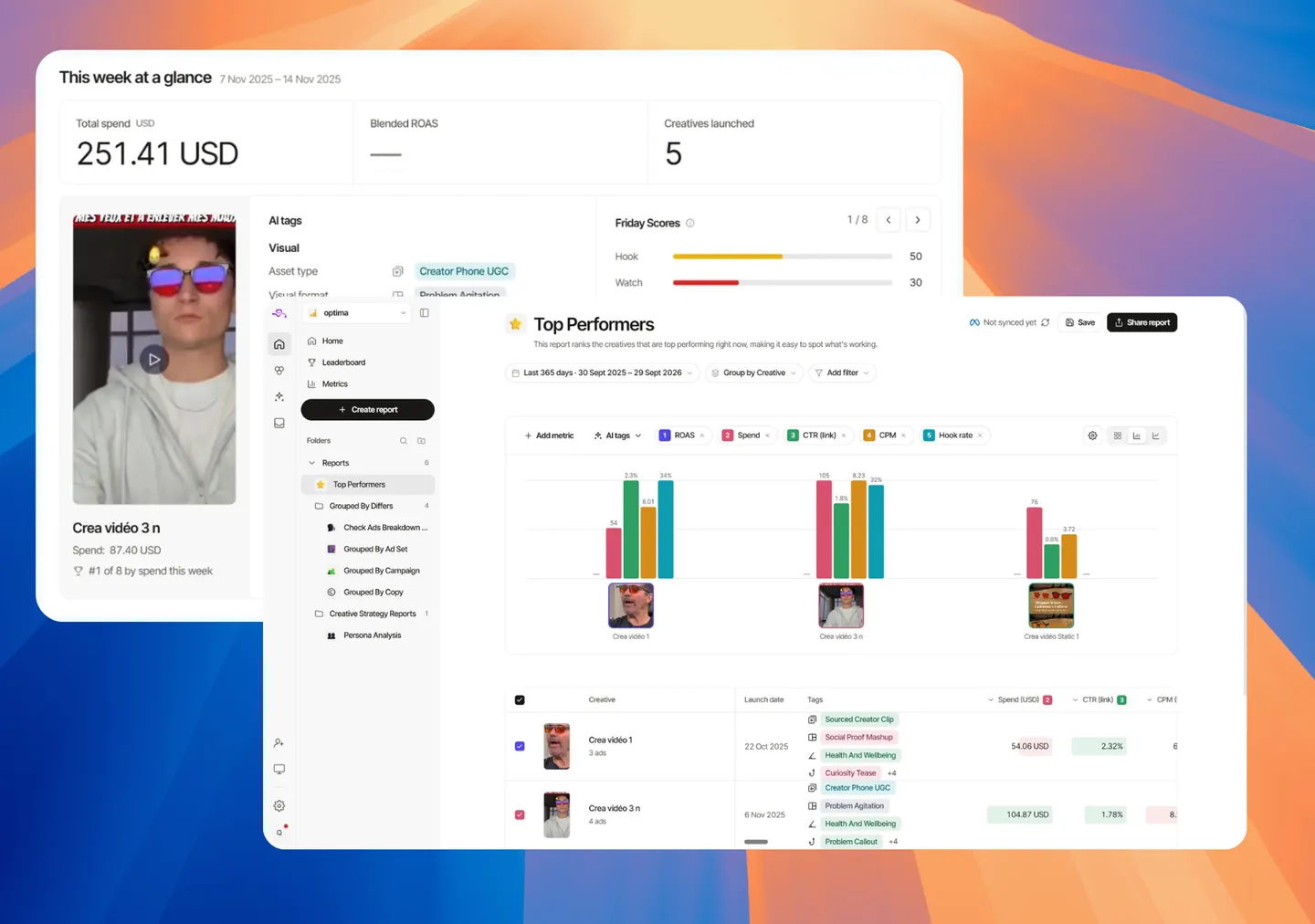
This frees the team to spend more time investigating results and developing better experiments.
2. Connecting Creative Decisions to Performance Is Difficult
Advertising performance is influenced by multiple variables, including the creative, audience, offer, placement, landing page, and campaign setup.
This makes it easy to draw conclusions that the data doesn't actually support.
For instance, if a testimonial ad outperforms a product demonstration, you cannot automatically conclude that testimonials are always more effective. The ads may differ in several other ways, or the result may reflect differences in delivery and audience exposure.
A stronger analytical approach compares relevant groups, isolates variables when practical, and looks for patterns across multiple observations.
Creative analytics helps organize the evidence, but sound interpretation remains essential.
The goal is to develop better-supported hypotheses, then validate them through further testing.
3. Turning Reports Into New Creative Ideas Is a Separate Skill
Identifying a performance pattern is not the same as knowing how to use it.
A report may reveal that problem-focused hooks perform well, but your team still needs to turn that observation into compelling concepts, scripts, visuals, and briefs.
Without a clear process for applying insights, analytics risks becoming an exercise in reviewing historical results.
To avoid this, connect every meaningful finding to a potential action.
A strong workflow might involve identifying a promising messaging angle, developing several distinct executions, testing those executions, and feeding the results into the next round of creative development.
This creates a continuous feedback loop between analysis and production.
How Creativity Helps You Get More From Creative Analytics
Creativity is built to help e-commerce brands and marketers connect advertising performance with the creative decisions behind it.
Rather than relying exclusively on campaign-level summaries, Creativity helps you examine your advertising through creative patterns, making it easier to investigate what is working and identify directions worth exploring.
Analyze Creative Performance, Not Just Ad Metrics
Performance dashboards can tell you which ads generated results. Understanding the creative behind those results requires a more detailed view.
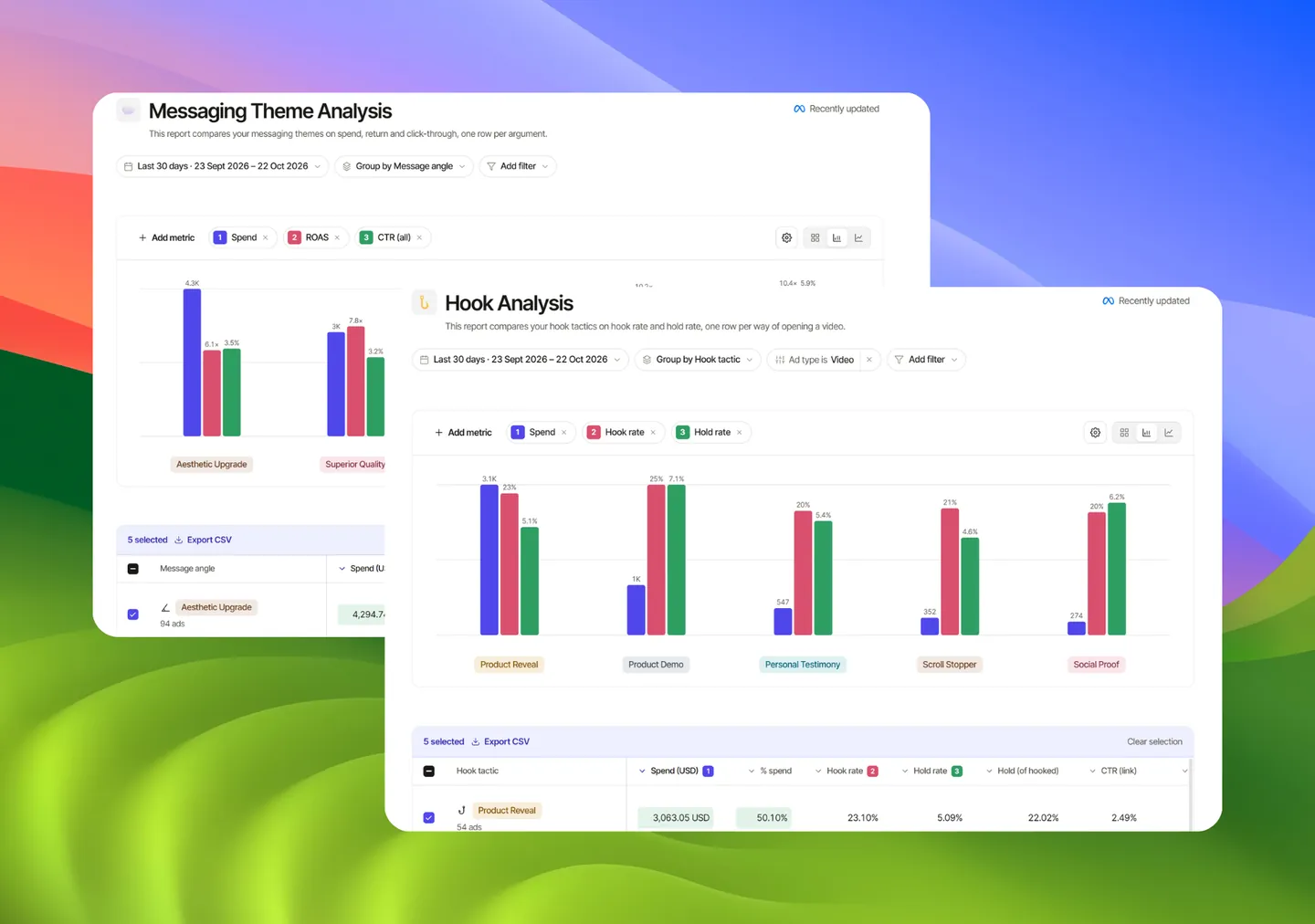
Creativity's creative analytics capabilities help you compare creative attributes and performance indicators through reports focused on areas such as hooks, visual styles, messaging themes, and audience personas.
This gives you a structured way to investigate questions like:
- Which hook approaches are associated with stronger video retention?
- Which visual formats generate promising results?
- Which messaging themes deserve further testing?
- Which audience personas respond to different creative approaches?
These comparisons help turn your advertising history into a resource for planning future campaigns.
Use AI Tags to Organize Your Creative Library
Analyzing a growing library of ads becomes difficult when every asset must be reviewed and categorized manually.
Creativity's AI Tags feature automatically classifies creatives into categories such as hook type, creative format, messaging angle, audience persona, offer type, and visual style.
Identify Promising Directions for Your Next Ads
Creative analytics becomes more valuable when the findings influence what you produce next.
Creativity helps you examine the relationship between creative characteristics and advertising outcomes so you can develop more informed ideas for future tests.
For example, if your analysis suggests that a particular messaging angle deserves further exploration, you can build new concepts around that angle while varying the hook, visual treatment, or format.
The objective isn't to reproduce the same ad indefinitely. It's to understand which elements may be contributing to its performance and use that knowledge to develop new creative variations.
Build a Repeatable Creative Learning Process
A sustainable creative strategy depends on learning from every round of testing.
With Creativity, you can use creative analysis and AI-powered categorization to support a workflow that connects performance review, insight generation, and future creative development.
Over time, this approach can help your team build a clearer understanding of its advertising history, reduce dependence on scattered reporting processes, and make creative testing more systematic.
The result is a more informed way to approach advertising: fewer decisions based purely on intuition and more experiments guided by evidence.